
2 March 2026
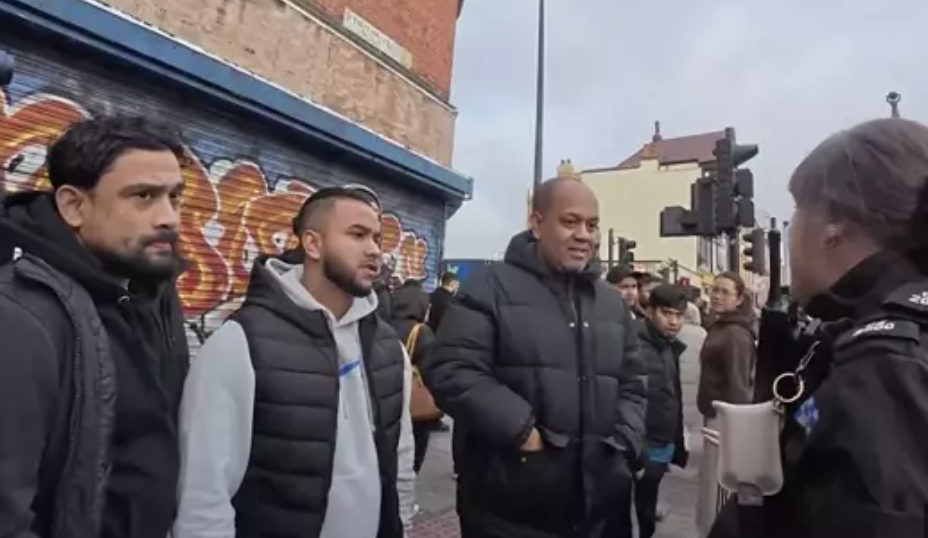
Christian street preachers have increasingly fallen victim to cowardly policing and a troubling distortion of the Public Order Act.
Two weeks ago, however, a lone female Metropolitan Police officer provided a rare and welcome defence of free expression. Confronted by a group of Muslim men who were harassing a Christian street preacher, she firmly upheld the principle of lawful free speech. The exchange, captured on video, has since gone viral — offering a rare example of common-sense policing in a climate where such incidents are all too uncommon.
Addressing the crowd, the officer stated: “In this country, we have freedom of speech,” before adding, “I understand you guys don’t want to hear it, so I would just recommend that you walk away and don’t listen to him.”
The men appeared shocked that she had not simply arrested the preacher — as has too often occurred in similar situations. They attempted to pressure her into action by ridiculously claiming they were in “a Muslim area”. The officer calmly rejected this assertion, pointing out that there is no such thing as a “Muslim area” in London.
Under considerable pressure, she demonstrated a clear understanding of the law: peaceful preaching in a public place is protected by Article 10 of the European Convention on Human Rights (ECHR). The fact that bystanders may feel offended — however strongly or loudly — does not in itself make speech unlawful.
Regrettably, this officer appears to be the exception rather than the rule.
Christian street preachers have increasingly been subjected to heavy-handed policing and a misapplication of public order legislation. In April 2021, 71-year-old Pastor John Sherwood was arrested by Metropolitan Police officers after stating that, in his view, the family unit as ordained by God consists of a mother and father. Passers-by complained that his comments amounted to homophobic hate speech. He was arrested, detained overnight and charged with a public order offence. In 2022, Uxbridge Magistrates’ Court acquitted him, affirming his right under Article 10 “to hold opinions and to receive and impart information and ideas without interference by public authority”.
In November 2025, Dia Moodley — a 58-year-old father of four and evangelical Christian — was arrested on suspicion of a racially or religiously aggravated public order offence after delivering a street sermon in which he commented on Islam and trans ideology. He was released on bail with conditions preventing him from entering the city. Police later returned to his home in January to question him again.
Mr Moodley said: “I am a law-abiding citizen, and it feels surreal that the police have criminalised me so harshly and repeatedly merely for peacefully expressing my Christian views in the public square.
“Unfortunately, I believe that the police view me, a Christian pastor, as an easy target and are afraid of others being offended by my lawful speech. This is two-tier policing in action.”
This is not the first time Mr Moodley has faced police action for street preaching. In 2024, he was investigated after commenting on Islam and stating that sex is binary outside Bristol University.
In 2021, he was reportedly instructed — without clear legal basis — not to comment on any religion other than Christianity. His case has since drawn international attention, including engagement with officials from the US State Department. It forms part of a growing number of incidents that have prompted concern within the Trump administration, which believes the UK faces a serious free speech problem.
These cases are particularly concerning as the Government finalises its proposed non-statutory definition of Islamophobia, now framed as “anti-Muslim hostility”. This definition risks chilling lawful criticism of Islam, its history and practices, and may deter open discussion of sensitive issues, including the grooming gangs scandal.
Furthermore, gender-critical beliefs are protected under the Equality Act 2010. That protection was reinforced by the Supreme Court’s ruling last year confirming that the legal definition of a woman is based on biological sex.
Other troubling incidents reinforce the pattern. British Transport Police have reportedly halted gospel leafleting outside King’s Cross Station, with one officer stating: “I just think it’s wrong.” In Leeds, a street preacher was prosecuted under Section 4A of the Public Order Act after misgendering a transgender heckler.
Taken together, these cases suggest that the targeting of Christian street preachers — and the expansive interpretation of public order legislation — is not isolated, but systemic.
While the actions of the lone Metropolitan Police officer provide reassurance that some officers remain committed to upholding the law impartially, the problem appears institutional rather than individual. The Metropolitan Police Commissioner, Sir Mark Rowley, should ensure that the conduct of this officer is reflected in training for serving officers and recruits alike — particularly in responding to complaints about individuals lawfully exercising their right to speak in public.