
16 March 2026
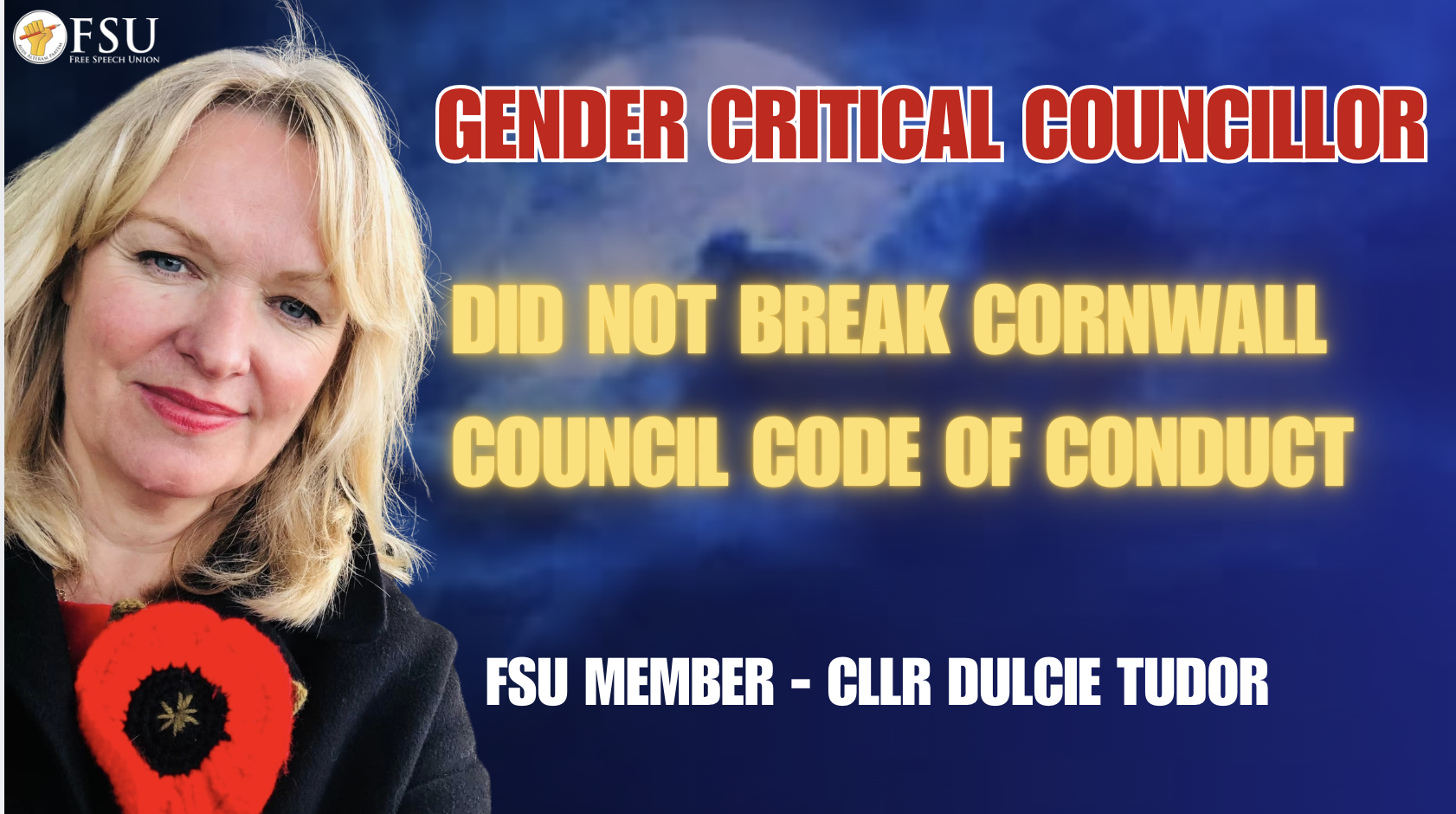
Independent councillor Dulcie Tudor has been cleared after Cornwall Council investigated whether she had breached its code of conduct following complaints about gender-critical posts on social media.
Nine complaints were lodged against Cllr Tudor after she expressed her gender-critical views online.
Dulcie has served as an independent councillor in Cornwall for eight years and is one of a growing number of elected representatives facing complaints procedures after expressing gender-critical views. Critics say such processes are increasingly being used by unelected officials to silence political speech.
Last November, Cllr Tudor responded to a Facebook post claiming that women are not at risk of harm from trans-identifying males. She disagreed, and nine complaints were subsequently submitted against her.
Gender-critical beliefs are protected under the Equality Act 2010 and were reaffirmed by last April’s Supreme Court ruling that the legal definition of a woman is based on biological sex, not gender identity. Despite this, Cornwall Council commissioned an external lawyer — at taxpayers’ expense — to investigate the complaints.
Cornwall Council has now confirmed that no further action will be taken after the external adviser concluded that Cllr Tudor had not breached the council’s code of conduct.
This is a victory for Dulcie, for free speech and for common sense.
The Free Speech Union supported Cllr Tudor throughout the process and wrote to the council before it launched the external investigation. Cornwall Council’s own legal advice has now confirmed that the FSU was correct on two key points: Cllr Tudor’s views were a legitimate expression of her political opinion and benefit from enhanced protection under Article 10 of the European Convention on Human Rights. It therefore did not matter if some people were offended by what she said. She had every right to express her views.
The council could have saved taxpayers’ money had it accepted the arguments set out in the FSU’s letter. Instead, public funds were spent on external legal advice. We are pleased that the council has now recognised this position, and other councils would do well to take note.
The investigation concluded that Cllr Tudor’s comments were protected by Article 10(1) of the European Convention on Human Rights (ECHR) and that the posts “do not constitute direct or indirect discrimination against trans individuals”.
Responding to the decision, Cllr Tudor wrote on Facebook: “I wonder how much of your money was wasted on an ‘external expert’ to tell the council that it couldn’t punish a democratically elected councillor for expressing a view the vast majority of people know to be true.”
A spokesperson for the Free Speech Union said: “We are seeing increasing attempts to weaponise the code of conduct complaints process against elected representatives, and Dulcie’s case is one of the most egregious examples we have seen. It is great news that the council has recognised there is no case to answer, and we were pleased to support her throughout this process.”