
Labour's jury trial reforms are a threat to free speech, says former High Court judge
29 June 2026
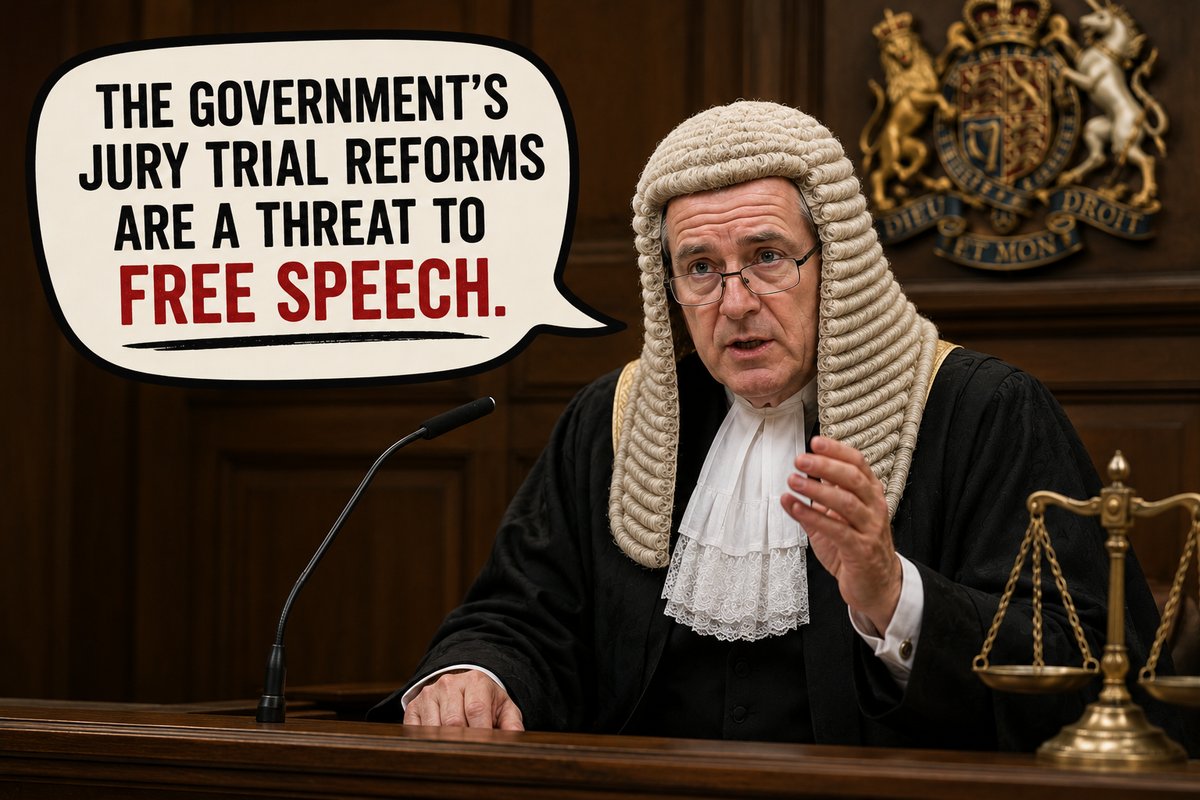
Sir Keir Starmer has led the most authoritarian government in a generation. Many of the policies that his administration has implemented – or at least attempted to – have directly threatened our fundamental right to free speech.
The policy that has arguably taken the proverbial biscuit is the Justice Secretary's plan to curb our ancient and precious right to trial by jury – a cornerstone of our criminal justice system with roots stretching well beyond Magna Carta in 1215.
Criticism of this sinister policy has been abundant, including from members of the outgoing Prime Minister's own legal class and his backbench MPs.
Sir Stephen Mitchell, a former High Court judge, has said that the plans put forward by the Labour Government threaten freedom of speech and have created a "golden opportunity" for the Government to bypass jury trials in "sensitive" cases – such as Public Order offences where free speech and the freedom to protest are at stake.
We have seen, especially in the wake of the heinous Southport stabbings, Public Order legislation harnessed to silence protest and dissent. The Free Speech Union supported Royal Marine veteran Jamie Michael, who was arrested at work and charged with stirring up racial hatred after a Labour Party staffer reported a twelve-minute video he shared on Facebook calling for people to protest against mass immigration. It took a jury just seventeen minutes to find him not guilty.
Another example is FSU member James Cooper. James attended a protest following the Southport murders outside a hotel housing asylum seekers, where there were reports that male migrants had been exposing themselves in a local park frequented by young children. When the protest turned heated, James attempted to leave. He was arrested and charged with violent disorder under Section 2 of the Public Order Act 1986, an offence carrying a maximum sentence of five years' imprisonment.
The Free Speech Union supported James and, after around two hours of deliberation, the jury unanimously acquitted him. This verdict – and that of Jamie Michael – once again demonstrates the importance of jury trials, an ancient right the Government wishes to dilute, in cases involving freedom of expression and protest.
Sir Stephen has said: "The jury remains a citizen's best protection against ill-conceived or perverse prosecutions based either on an ill-judged assessment of the strength of the case, or on evidence of otherwise doubtful veracity."
"The role of the jury also extends to protecting citizens from freedom-restricting legislation enacted by a government to micro-control citizens' activities in relation to freedom of speech and freedom to protest. This important protection will now disappear."
As many – including the Free Speech Union – have warned, the Government did not include these sweeping reforms in its manifesto at the 2024 General Election and therefore has no mandate to enact them. Sir Stephen also criticised the Government for proceeding without a "bona fide consultation exercise" and highlighted how MPs had only thirteen days to digest the "complex" and near "impenetrable" proposals in the Bill before being required to vote on them at second reading.
Since Sir Keir Starmer announced his resignation, his likely successor Andy Burnham has expressed concerns over the policy and called for a "pause" to allow time to consider whether to pursue it. The Free Speech Union sincerely hopes that he decides to abandon this sinister policy, and encourages anyone who values English liberty – particularly free speech – to join over 50,000 others and sign our petition calling on the Government to save jury trials.
Sir Stephen has also echoed concerns raised by the Lady Chief Justice, Baroness Carr, warning that curbing jury trials would expose judges to "pressures, threats and dangers" – both physical and psychological – as a sole judge, rather than a jury, becomes responsible for determining the defendant's fate.
He said: "Individual judges may also become the subject of the sort of statistics and predictions more commonly found in betting shops, with even a potential for the emergence of an underworld 'postcode sentencing lottery'."
Sir Stephen also cited the value of common sense that derives from twelve random members of society pooled to form a jury, and how important that is for the public to maintain trust in the criminal justice system.
He said: "The very presence of a jury can act as a restraining factor upon any temptation, to which either 'bench or bar' might fall, to display eccentricities or rank unfairness."
"The presence of a jury underpins the defendant's confidence and the public's confidence in the fairness of criminal trials. This dimension would be dangerously absent in a 'judge alone' trial."
David Lammy has claimed that the only way to solve the backlog of 80,000 cases in the Crown Court is to slash our right to trial by jury – despite there being no credible evidence to support this. In fact, the Institute for Government has shown that the reforms are expected to save only two per cent of Crown Court time, not the twenty per cent promised by ministers.
At the same time, a significant percentage of the 532 Crown courtrooms across England and Wales are not sitting on working days. In his paper criticising the Government's policy, Sir Stephen has questioned the need for sweeping a move given emerging evidence that other, less divisive changes—such as increasing the number of sitting days for judges – were beginning to bring the record backlog of cases down.
He went as far as to say that the reforms would actually waste more time, because judges would be required to determine before a trial which cases should be heard in judge-only courts on the basis that they were "likely" to result in a sentence of three years or below.
Sir Stephen also questions the inherent unfairness of the policy and its consequences: a defendant of good character with a clean record would most likely have their case heard in a judge-only court, whereas someone with a string of previous convictions would be entitled to a jury trial.
He said: "A defendant's 'good character' is an almost certain passport to trial by 'judge alone', whereas an 'old lag' with years of convictions and prison sentences behind him is a very promising candidate for 'trial by jury'."
Adding: "Some might regard this inevitable, and eminently avoidable outcome, as unjust if not outrageous. It is certainly an affront to any notion of 'justice'."
We fought cases like this one — and we could fight yours.
The Free Speech Union defends people who are punished for speaking the truth. Join 49,000 members who speak freely, knowing the FSU has their back. From £29.99/year.
Join the FSU Today