Major policing reforms delayed until Autumn as Labour changes its leader
17 July 2026
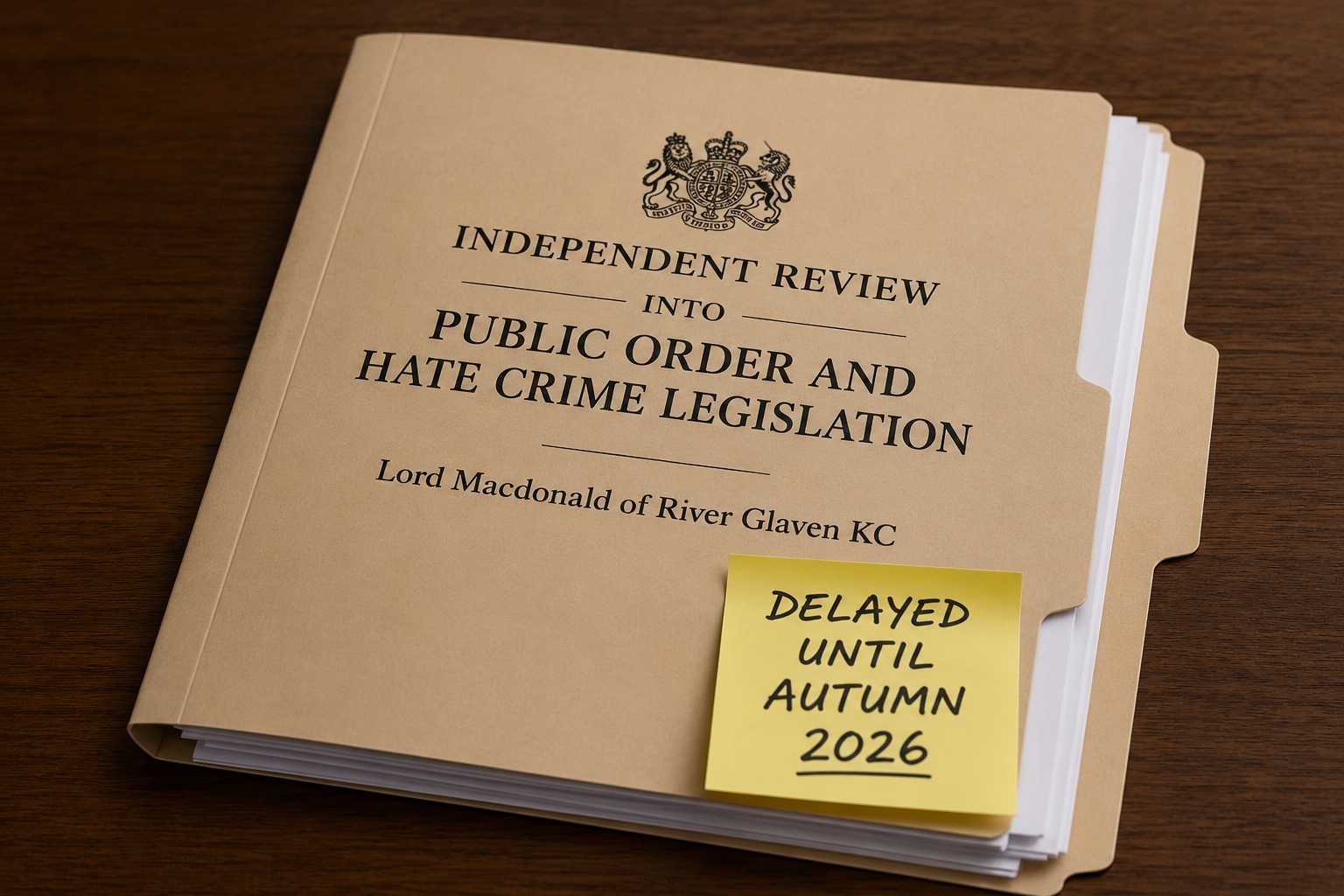
A major overhaul of public order law has been delayed until the Autumn as Keir Starmer leaves office and Andy Burnham takes the keys to 10 Downing Street.
Lord Macdonald of River Glaven KC was commissioned by the Home Secretary, Shabana Mahmood, in December to review public order and hate crime legislation.
The independent review was submitted to the Home Secretary on 29 May for her and other Home Office ministers to assess its findings. In the House of Lords, the Free Speech Union's General Secretary and founder, Lord Young of Acton, has consistently pressed the Lords Home Office Minister, Lord Hanson of Flint, to publish the report's findings. Lord Young had gained assurances from the minister that it would be published ahead of Parliament rising for summer recess, yet the Government has reneged on that promise.
A review of complex public order and hate crime legislation has been long overdue and has become particularly poignant given the increase in protests across the country and the number of people who have been arrested under public order legislation, which has resulted in the suppression of their fundamental right to free speech and protest. The law has been applied inconsistently, which has undermined public trust in the police and given uncertainty to the police and members of the public.
Shabana Mahmood had been preparing to publish this landmark review, which seeks to bring greater clarity to police forces across the country. However, the Cabinet Office has put publication on hold as the transition from Keir Starmer to Andy Burnham takes place. It is now being reported that the findings will be published in the Autumn.
The Free Speech Union has been on the frontline defending those who have fallen foul of this growing trend. The distortion and manipulation of public order legislation were seen most acutely in the wake of the heinous Southport murders and the protests that followed. The Free Speech Union defended a number of people, including James Cooper and Royal Marine veteran Jamie Michael.
Given the transition at the top of the Labour Party and Government, the Cabinet Office has stepped in and pressed pause on the publication of Lord Macdonald's review. Officials have warned that going ahead with announcing the findings would have breached rules enforced by the all-powerful Cabinet Secretary Antonia Romeo, which forbid new policies or announcements — beyond what has been included in the King's Speech — between Sir Keir Starmer's resignation as Prime Minister and Andy Burnham entering Downing Street on 20 July.
As a result of this delay, police forces, councils and other law enforcement agencies will remain in the dark and will continue to inevitably infringe upon the free speech rights of protestors.
It has been reported that the Home Office had sought permission to publish the review, but was blocked by the Cabinet Office. Police chiefs are left facing a summer of continued frustration. One source told The Telegraph: "The point stands that there is a huge mismatch in legislation and guidance for police that adds a lot of confusion as to how they police protests. There's a need to clear that up. It's essential."
Sir Mark Rowley, the Commissioner of the Metropolitan Police, who has faced stark criticism for policing failures, has publicly criticised public order and human rights legislation, calling it "inadequate" and slamming its ambitious nature that makes it difficult for police officers to deal with fast-moving protests.
Lord Macdonald, the former Director of Public Prosecutions, is believed to be sceptical about extending the power of both the police and Government to ban marches, which could have a chilling effect on free speech.
In his review, the Home Secretary asked Lord Macdonald to assess whether the legislation was "fit for purpose", whether it adequately protected communities from intimidation and hate. The primary focus of the review was to determine whether existing public order and hate crime legislation struck a "fair balance between freedom of expression and the right to protest with the need to prevent disorder and keep communities safe."
Ms Mahmood has taken a tough line on protest since becoming Home Secretary and has indicated that she would like to give the police more powers to ban protests.
A five-point Free Speech Bill
This week, Jon Holbrook, a member of the Free Speech Union's Legal Advisory Council, published an important report for the Prosperity Institute charting the decline of free speech in Britain and setting out a five-point Free Speech Bill to reverse it.
Jon has argued that the expansion of vaguely defined speech offences — using terms such as "grossly offensive", "abusive", "insulting" and "stirring up" — has handed governments sweeping powers to decide what people can and cannot say.
The proposed Bill would repeal Section 5 of the Public Order Act 1986, abolish laws based on the concept of non-violent "hate speech", and restore the principle that free speech protects not only popular opinions, but also those that are contentious, provocative and unwelcome.
Read more in The Telegraph and check out Jon's Free Speech Bill.
Public order law failing to protect your free speech?
The FSU is pressing ministers to publish this review and has defended members, including James Cooper and Jamie Michael, prosecuted under this confused law. Join 45,000 members. From £29.99/year.
Join the FSU Today