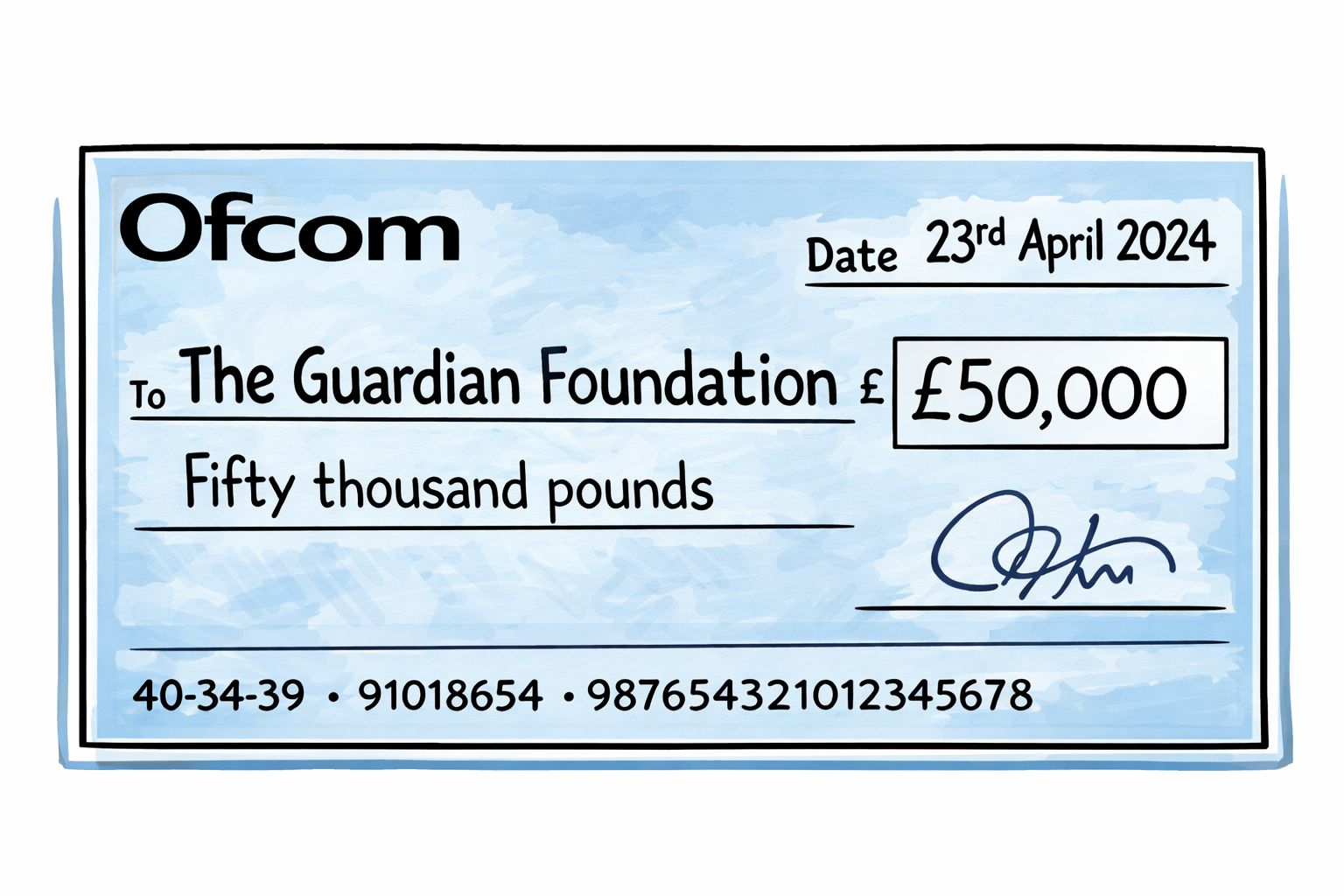
Ofcom dishes out £50,000 donation to The Guardian's charity
7 April 2026
Ofcom is back in the headlines – once again, for the wrong reasons.
The broadcasting regulator has come under scrutiny after filings revealed it awarded £50,000 in 2025 to The Guardian Foundation, the charitable arm of The Guardian, to support its “Untold Stories” project. The initiative aims to teach news and literacy skills to children in deprived areas of London and Greater Manchester.
On its face, the funding falls within Ofcom’s statutory duty to promote media literacy. But the decision to channel public money into a charity closely linked to a prominent news outlet has raised eyebrows – particularly given Ofcom’s increasingly assertive infringements on other parts of the media landscape.
Ofcom does not regulate newspapers. Its remit is focused on broadcast media and, more recently, online platforms. That makes its financial support for a Guardian-linked project an unusual move, and one that invites questions about consistency and impartiality.
Those concerns come at a time when the regulator is already facing mounting criticism over its overzealous enforcement of the Online Safety Act. Since the legislation was passed in 2023, Ofcom has assumed sweeping new powers to oversee online content – powers that have encroached on freedom of speech in both the UK and US.
The regulator has also clashed with broadcasters. Most notably, it lost a High Court challenge brought by GB News over a ruling that programmes hosted by former Conservative MP Sir Jacob Rees-Mogg and featuring other politicians breached rules on politicians presenting news. The judgment marked the first time Ofcom had been successfully challenged in court over its broadcasting standards decisions.
Reform UK leader and GB News presenter Nigel Farage has also weighed in on the controversy, questioning whether Ofcom is fit to operate as an impartial regulator within the media landscape.
“This is exactly the sort of cosy media club that GB News seeks to disrupt. Payments like this continue to raise questions about Ofcom’s role in the media landscape.”
Beyond the UK, Ofcom’s approach is beginning to attract international attention. Senior figures in the United States, including members of the Trump administration, have voiced concern about the implications of the Online Safety Act for free speech. Similar criticisms have been levelled at the European Union’s Digital Services Act. The Trump Administration has said that the Online Safety Act was a threat to the First Amendment rights of US citizens and was negatively impacting US technology companies.
What was billed as targeted legislation to protect children online has evolved into something far broader. The regulator has demonstrated extraterritorial ambitions that pose a direct threat to free speech. Against this backdrop, Ofcom’s decision to fund a Guardian-affiliated project risks reinforcing perceptions of uneven treatment across the media sector.
“It’s genuinely odd that Ofcom has given £50,000 to The Guardian when, almost alone among UK newspapers, it eschews any external regulation of its content.
“If you’re misrepresented by The Guardian, your only recourse is to complain to its internal ombudsman – in other words, it marks its own homework. If only Ofcom granted the same latitude to GB News and Elon Musk.”
Ofcom has defended the grant, stating that the Guardian Foundation – separate from The Guardian’s editorial operation – was awarded the contract through a “robust and competitive tender process” as part of its Making Sense of Media programme.
Even so, the episode adds to a growing list of controversies that are prompting closer scrutiny of the regulator’s role, reach, and judgment. Ofcom really isn’t helping itself.
Further details have been reported in The Telegraph.
Ofcom’s overreach threatens free speech — help us push back.
The FSU is challenging regulators who abuse their power to silence dissent. Join 45,000 members defending free expression. From £29.99/year.
Join the FSU Today