RAF cadet suspended after calling Islam the biggest threat to the UK
22 April 2026
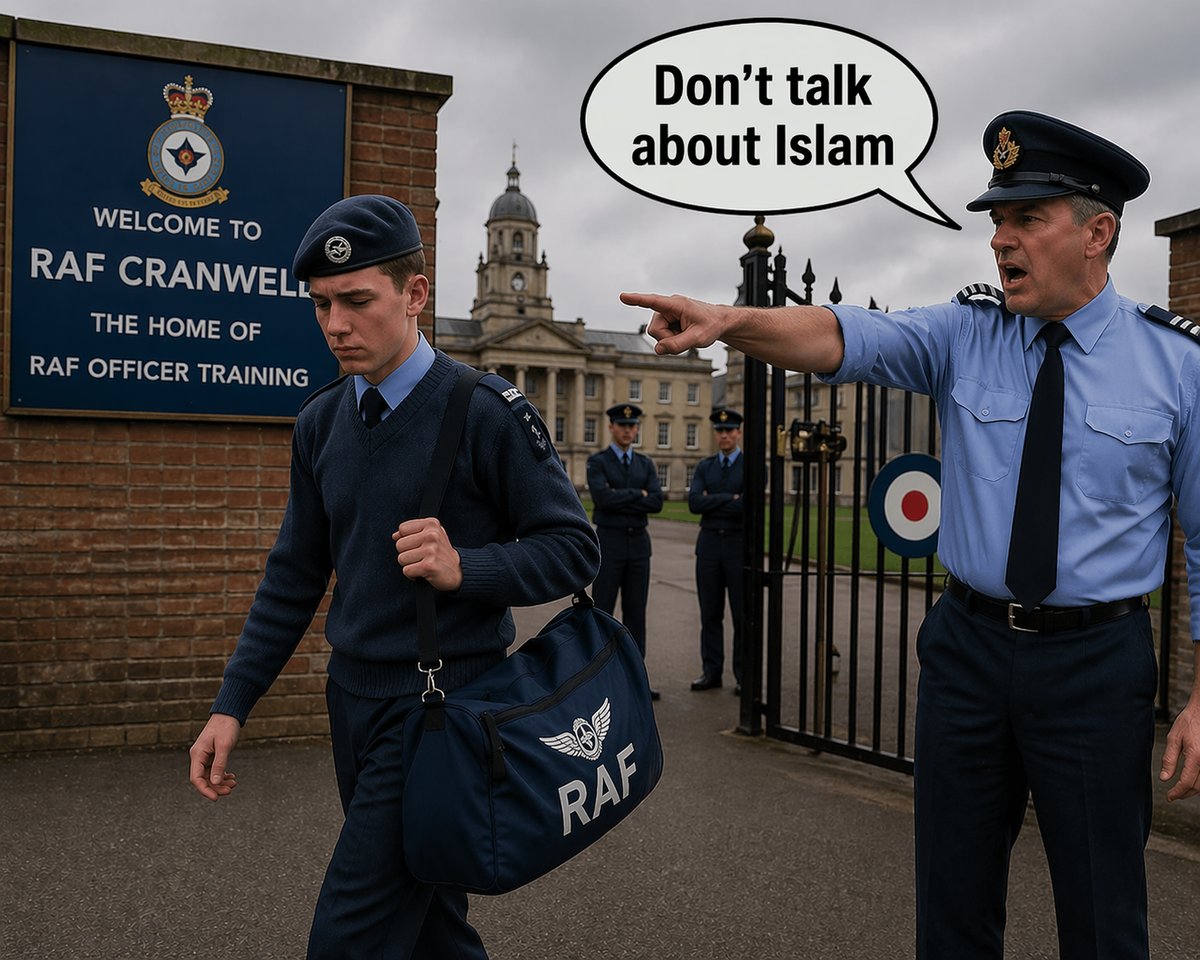
Another week brings yet another example of the zealous enforcement of Britain’s de facto Muslim blasphemy law. The suspension of an RAF cadet for describing Islam as the biggest threat to Britain during a presentation on national security should concern us all. If servicemen and women cannot speak freely about what they perceive to be genuine threats to UK security, we are in serious trouble.
While many people have been deterred from criticising Islam – and from discussing the threat posed by Islamism and Islamist extremism – thanks to the Government’s official definition of Islamophobia, now repackaged as ‘anti-Muslim hostility’, one might still have assumed that our military would be able to speak openly about genuine threats to national security. It appears not.
According to reports in the Daily Mail, shortly before Easter a young RAF cadet was suspended from his 24-week officer training course after stating that ‘Islam is the biggest threat to Britain’. The cadet was training at RAF Cranwell in Lincolnshire, which is responsible for preparing the next generation of servicemen and women tasked with defending the country. The remarks were made during a Q&A session on national security, in which around 50 students were asked to give presentations addressing what they believed to be the primary threat to Britain’s national security. After stating his view, the cadet was removed from the training course.
An RAF spokesperson confirmed that an investigation is ongoing, stating: ‘We are aware of an alleged incident of inappropriate behaviour involving a cadet at RAF Cranwell. An investigation is ongoing. We are unable to comment further.’
Islamist extremism is widely recognised as one of the most serious threats to the UK. Since 2022, 20 plots have been linked to the Islamic Republic of Iran, with the Government describing the threat of state-sponsored terrorism as ‘persistent and unacceptable’. The treatment of this cadet is particularly striking given that the Defence Secretary, John Healey, has indicated that Britain’s terror threat level is being reassessed as a result of tensions involving Iran. The UK has also suffered some of the most egregious Islamist terrorist attacks in recent history, including the 7 July 2005 London bombings, in which 52 people were killed and more than 770 injured. In 2017, Islamist terrorists killed 22 people in the Manchester Arena attack following an Ariana Grande concert.
The cadet’s suspension has prompted widespread outcry, including from retired Rear Admiral Chris Parry, who described the episode as a failure of the military to encourage proper debate and critical thinking among members of the armed forces. Speaking to GB News, Mr Parry said: ‘Clearly Islamic extremism is the issue and not Islam, but how are young people expected to develop critical thinking around these complex issues if they are shut down in this way?’ He also raised an important question: would the cadet have faced the same disciplinary action had he claimed that the ‘far right’ posed the greatest threat to Britain’s national security?
This is yet another example of a de facto Islamic blasphemy law embedding itself within British institutions.
Worried about speaking freely at work?
Nobody should face sanctions for expressing a genuinely held view about national security. Join 45,000 members of the Free Speech Union and ensure expert support is there if you need it. From £29.99/year.
Join the FSU Today