South Wales Police shelve Islamic blasphemy law after FSU legal threat
10 June 2026
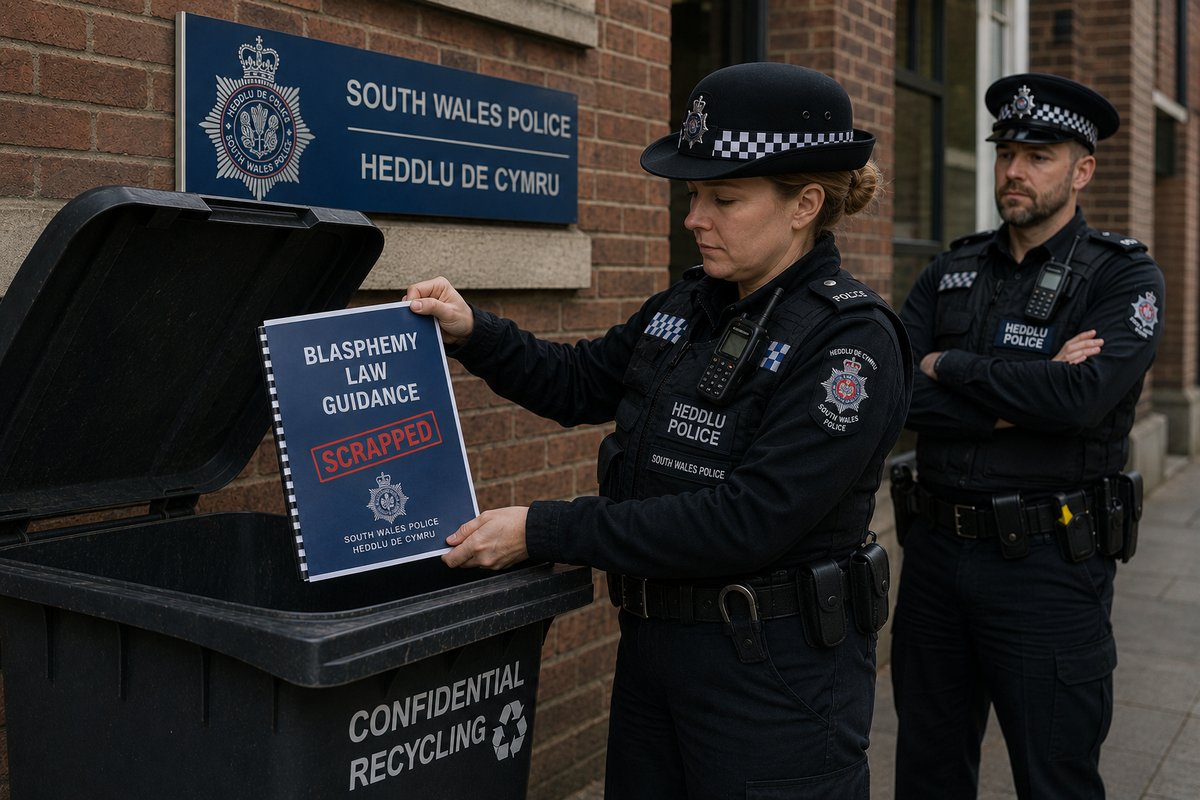
South Wales Police have shelved their controversial bespoke Islamic blasphemy law after the Free Speech Union threatened them with a judicial review.
The force has written to the Free Speech Union to confirm that it has now "paused" its adoption of an "anti-Muslim hostility" definition that went even further than the Government's own version, announced in March.
Under guidance issued to officers, they were instructed to log anything deemed to be beyond "legitimate criticism" of Islam. That would inevitably have included criticism of the hijab or halal food. More concerning still, it would have deterred individuals from speaking out on issues such as the grooming gangs scandal and Islamist extremism.
This guidance would have had a serious chilling effect on free speech by handing officers the power to decide what constituted acceptable speech relating to Islam and Muslims — in a country that abolished blasphemy laws 18 years ago.
Under South Wales Police's plan, anything logged as beyond "legitimate" discussion of Islam would be recorded as an "anti-social behaviour incident" — the successor to the draconian non-crime hate incident — and would appear in enhanced DBS checks, which could prevent individuals from obtaining a job, particularly as a teacher or carer.
Speaking to The Telegraph, General Secretary and founder of the Free Speech Union, Lord Young of Acton, said: "Blasphemy laws were repealed in this country 18 years ago, and we will do everything in our power to stop them being brought back by the back door."
The Free Speech Union wrote to South Wales Police demanding that they withdraw the guidance, warning that failure to do so would result in legal action by way of judicial review. In that letter, FSU lawyers argued that the guidance was incompatible with laws governing data protection and the protection of free speech.
Credit must also be given to the Conservative MP and shadow minister for equalities, Claire Coutinho, who referred the force to the Equality and Human Rights Commission, urging it to open an investigation on grounds of discrimination. Coutinho described the guidance as "a de facto blasphemy law, which only applies to the discussion of Islam" rather than any other religion.
Following the news, Coutinho said: "This guidance is an assault on free speech. Criticising religions and belief systems is a fundamental right in this country.
"As I said when the Government brought in this Islamophobia definition, it is only going to be weaponised by our public services to clamp down on free speech and interfere with our counter-terrorism and policing capabilities.
"We cannot put one religion on a pedestal above others without breeding more resentment and more division. That's why the definition has to go."
South Wales Police adopted this definition in the wake of the Government announcing their own official definition of Islamophobia — now repackaged as "anti-Muslim hostility" — in March.
But they went further. South Wales Police added their own additional instructions to officers, creating an even more restrictive category of speech that the Free Speech Union believes to be unlawful.
A spokesperson for South Wales Police said: "Following consultation, we are pausing the aligning with this definition in order to consider whether South Wales Police maintain or amends the adoption, pending guidance from NPCC.
"South Wales Police is committed to ensuring we are accessible, reliable and trusted by all of our communities."
While the force says it has "paused" the guidance, the Free Speech Union sees no way in which it can return to it.
Reacting to the decision, Lord Young said this should serve as a warning to all other public bodies — especially police forces — considering adopting their own Islamophobia definition.
Read more in The Telegraph and watch Lord Young's reaction here.
Should the police decide what you can say about religion?
The FSU forced South Wales Police to drop its de facto blasphemy law. Join 49,000 members defending free speech. From £29.99/year.
Join the FSU Today