
Ian Mactaggart Programme: a year of free speech on campus
5 August 2026
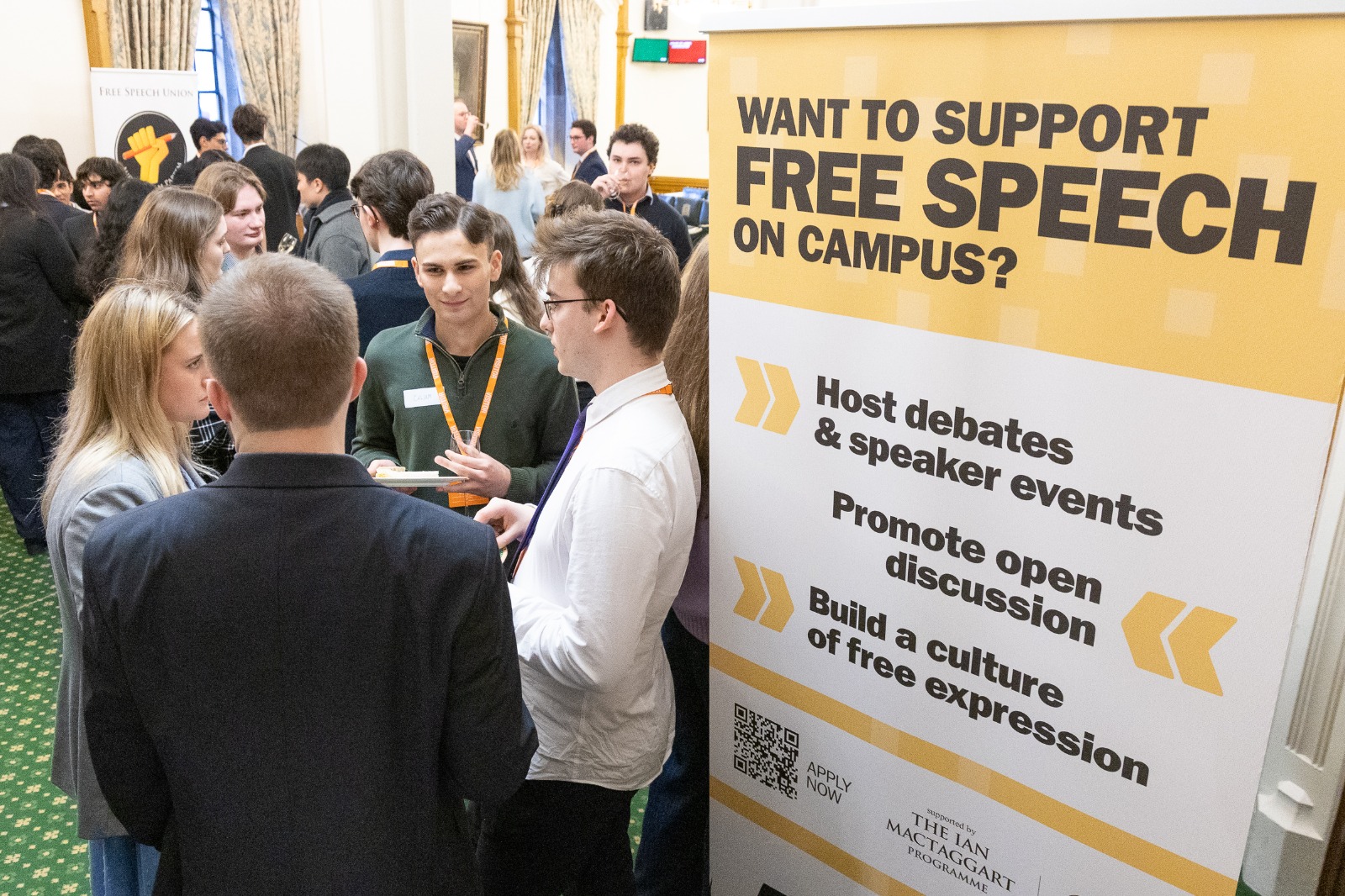
Since April 2023, the Free Speech Union has administered the Ian Mactaggart Programme. This is a grant-giving programme which supports young people, and especially university students, to promote open debate, independent thinking and free enquiry on campus. Student societies can apply for up to £1,500 per term, and individual students and young people up to the age of thirty can apply for smaller awards. Grants cover speaker events, debates, journalism, podcasts, conferences and publications. Applications are open year-round.
Ultimately, the Programme exists to support a genuine diversity of opinion and critical thinking, showcased this year in our support for more than sixteen societies and groups across the UK. As universities break for summer and we look ahead to a new academic year, we set out below the activities the Programme helped to support across the country.
Debating societies
Debating unions remain one of the key recipients of the Programme, and this year our grants supported term cards at six of them.
Durham Union Society hosted a wide-ranging programme including Baroness Hale, the former Slovakian Prime Minister Eduard Heger and the historian Ilan Pappé. The Union also hosted the gender-critical journalist Helen Joyce; the event attracted organised student opposition but went ahead without disruption, following the FSU's public support.
York Dialectic Union hosted over twenty events, including a debate on whether the United States is a rogue state, a discussion of the Raise the Colours campaign with Sir Alec Shelbrooke MP, and a talk with the feminist campaigner Harriet Wistrich on women in the justice system. The Union also introduced informal debate socials for students less confident in formal settings.
In Scotland, Edinburgh University Debates Union used their grant to host the flagship Ed Cup, which drew students from twelve institutions, and the Montgomery Cup, which brought students from the University of Central Missouri to Edinburgh. Members also ran debate workshops in schools across the country.
Exeter University Debating Union hosted eighteen events, ranging from the future of foreign aid to decolonisation and the American Dream, with audience questioning at every one — so that students could challenge speakers directly rather than simply listen.
Two of our grants went towards competitive debating: Liverpool Debating Union hosted the Liverpool IV, one of the UK's principal university competitions, which drew competitors from twenty-one universities, while Bath University Debating Society runs weekly British Parliamentary sessions and competes at universities nationwide.
Free speech societies
The Programme also exists to support students who want to found free speech societies where none existed, and to keep supporting them once they are established. Some of the societies below received a grant for the first time this year; others we have continued to support since their inception.
King's College London's Free Speech Society was founded this year with a Programme grant, and has since run around twenty weekly seminars alongside two major events: Helen Joyce and John Armstrong on gender ideology in universities, and David Betz on censorship and Britain's future. The society also launched a publication and podcast, Oldspeak.
Warwick Speak Easy Society hosted Sir Desmond Swayne MP in collaboration with the Warwick Economics Summit, the economist Bryan Caplan on free markets, an event with the founder of HASSLE on women's and girls' rights, and a joint event with Warwick Left Society on modern working-class politics.
Exeter Speak Easy Society worked through administrative disruption while building links with free speech societies elsewhere in the network, and members visited Brodie Mitchell at Royal Holloway to support his free speech case.
UCL Libertarian Society hosted the FSU's External Affairs Officer Connie Shaw on women's rights and free speech. The event faced organised protest but went ahead as planned and drew national press coverage.
Other societies
Not every society we support has free speech in its name or its stated purpose. Many exist to discuss subjects that are difficult and contested — and open debate is the precondition for having those conversations at all. We want the Programme to be broad enough to support societies that rely on free enquiry to achieve their aims.
The newly founded Cambridge University Society of Women used their grant to host a first year of events including Nimco Ali on FGM, Julie Bindel on the politics of prostitution and Joanna Williams on the future of feminism. Membership was free and tickets deliberately cheap, so that all students could afford to attend. The society featured in national press, met Kemi Badenoch and shadow cabinet members in Parliament, and briefed parliamentarians in the House of Lords on the experiences of gender-critical students.
At Durham, the Women in Politics Society used their grant to subsidise members' travel to London for visits to Parliament, the FCDO, Chatham House and the BBC. The society also held an International Women's Day gala and took part in the inaugural Women in Politics National Conference alongside societies from other universities.
Two of our grants went to student journalism. Hillhead Review Magazine at the University of Glasgow published nonpartisan opinion writing from across the political spectrum, ranging from defenders of Keir Starmer to voices from the University's Conservative Society and critics of the SNP, with our grant covering printing costs. Nottingham Advocate Magazine relaunched with a new cohort of student writers, the grant again covering the cost of printing editions.
Elsewhere, Cambridge University China Forum — a student society examining contemporary Chinese politics, business and media — hosted a civil service careers event, a fireside chat with the Director of the Institute of Directors, and talks on Chinese stock exchanges, journalism in China and contemporary Chinese politics. Finally, the University of Nottingham Pro Bono Society gives students hands-on legal experience by pairing them with people who need free legal assistance in housing, employment and consumer disputes.
One-off events, podcasts and projects
The Programme is not limited to funding societies. Individual students and young people aged 16 to 30 can apply in their own right for one-off events and projects, and this year several did.
Balliol College Philosophy Society at the University of Oxford hosted Lord Michael Gove, editor of The Spectator and former Cabinet minister, in conversation on whether the left has won the culture war. The event was free, open to the whole university and sold out, and Lord Gove was challenged on trans ideology, Israel, immigration and his criticism of experts during the Brexit era.
Discourse Collective and the podcaster Elliot Bewick applied for a grant to run Next Gen Live, a half-day event in South London aimed at a Gen Z audience, combining a debate on contemporary relationships, a lecture by the writer Joe Foley, and a live podcast recording with the philosopher Jonny Thomson.
The Conversation Cabinet is a current affairs podcast produced by the impressive sixth-form pupils Joshua Eames and Ethan Pearman, which records cross-political discussions for young audiences. This year they recorded with figures from across the political spectrum: Lord Young of Acton, Kwasi Kwarteng and Sir Jacob Rees-Mogg, the Labour MPs Natasha Irons and Will Stone, the left-wing influencer Tilly Middlehurst and the Restore UK supporter Young Bob. The podcast recorded in Bath, Cambridge, churches and Parliament, and was nominated for Best Student Podcast at the Political Podcast Awards 2026.
Finally, for the fourth year running, the Programme funded scholarships to the Living Freedom Summer School, a residential school for eighteen to thirty year olds on democratic values and free speech. Participants spend several days debating key issues related to freedom and free speech today. Our scholarships exist to ensure that financial circumstances do not determine who gets to take part.
Applying to the Ian Mactaggart Programme
Applications are open year-round. Student societies can apply for up to £1,500 per term for anything connected to promoting free speech. Individual students and young people up to the age of thirty can apply for smaller awards, typically between £100 and £250, for journalism, conferences, exhibitions, performances and talks. Applications are welcome from long-standing and newly founded societies alike, whether affiliated to a students' union or independent of one, and from students of any political persuasion or none.
Full details can be found at freespeechunion.org/ian-mactaggart-programme.
Want to fund free speech on your campus?
The FSU's Ian Mactaggart Programme funds students and societies defending open debate on campus. Join 50,000+ members. From £29.99/year.
Join the FSU Today