Labour backlash over Conversion Practices Bill as former health minister raises 'serious concerns' about risk of parents being prosecuted
28 October 2026
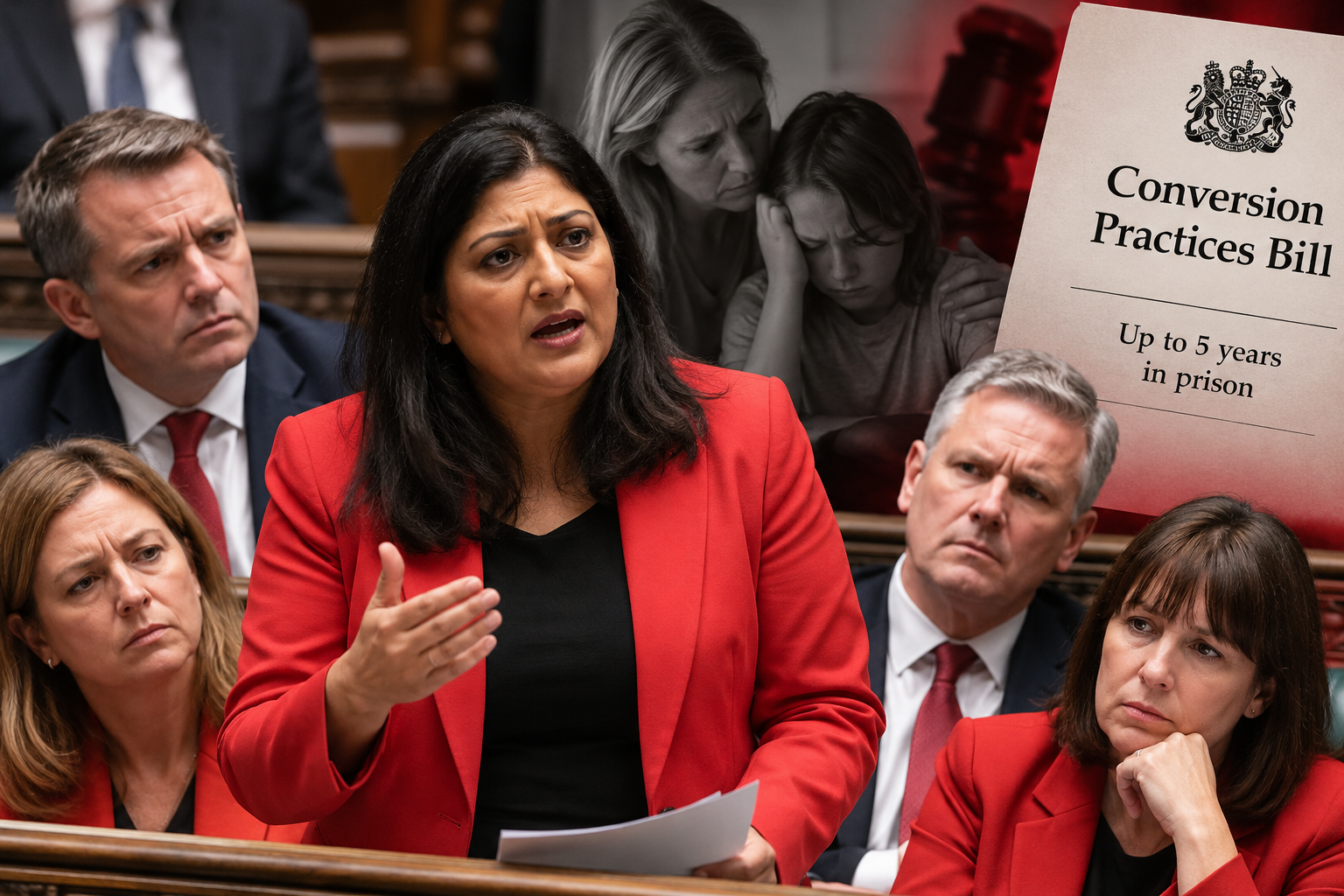
A former Labour health minister has broken ranks over the Government's draft Conversion Practices Bill, warning that it could see parents prosecuted for cautious and loving conversations with their own children.
Preet Kaur Gill MP, who served as a health minister earlier this year, warned that parents could face prosecution under the draft legislation. Under this bill, parents could face up to five years in prison for conversations with their gender-questioning children, including trying to dissuade them from pursuing medical interventions before the age of eighteen.
Ms Gill, the Labour MP for Birmingham Edgbaston, served as Parliamentary Under-Secretary of State for Health Innovation and Safety between May and July 2026. The former minister and social care worker acknowledged that the Government may be well intentioned in its aims, but said the drafting of the Bill risks actually harming children, and voiced her "serious concerns". It is a significant intervention from a Labour MP and former health minister — and one the Government should take seriously.
"Nobody should ever be subjected to abuse because of their LGBT identity. The intentions of the bill – seeking to protect vulnerable people – are laudable.
"Yet there are serious concerns about the draft text that undermine what has become clear in recent research about the vulnerability of children exploring gender ideology."
She added:
"As the Cass Review advised, parents and guardians must have freedom to take a cautious approach when navigating sensitive topics with their children. The evidence shows that devices such as chest-binders or puberty blockers can cause long-term bodily damage.
"But by criminalising words that amount to 'economic' and 'emotional pressure', the bill could undermine this advice from Cass, and ensnare parents who simply want to properly examine the risks involved with early 'transition', and where appropriate, advise against rushing into the use of such serious interventions.
"It would be wrong if a bill created to protect vulnerable people would overreach into potentially causing unnecessary censorship of important and loving conversations within families."
Ms Gill did not dispute that genuine abuse should be punished; she disputed that the Bill, as drafted, confined itself to genuine abuse. That is precisely the objection that the Free Speech Union and others have pressed since the draft was published: the problem lies not in the Government's stated intentions but in the words on the page, which are what a court will apply. Abusive conversion practices are already rightly illegal in this country, so what is it that this new law is actually seeking to ban? It appears to be the well-intentioned conversations of parents and therapists with gender-confused children.
A Bill at odds with Cass
Ms Gill, a former social worker, warned that the Bill risked "censorship" and threatened to undermine the findings of the 2024 Cass Review into gender care. The Review (the independent examination of NHS gender identity services for children and young people, led by the paediatrician Dr Hilary Cass) found the evidence base for medical interventions such as puberty blockers to be weak, and recommended a holistic, cautious, and exploratory approach in place of automatic affirmation.
Cass urged clinicians and families to slow down, to explore the causes of a child's distress, and to keep options open; the draft Bill would treat conduct intended to stop a child from adopting a "transgender identity" as a potential criminal offence, and would weigh "psychological or emotional pressure" as evidence that such conduct was abusive. A parent who followed the Review's counsel of caution could, on the face of the draft, be described as doing exactly what the Bill prohibits. When the draft was published in June, Dr Cass herself said that the legislation must allow healthcare professionals to do their jobs without fear of litigation. Ms Gill's point was that parents deserve the same assurance, and that the draft does not give it to them.
What HM Opposition has said
The Shadow Minister for Women and Equalities, Joy Morrissey, said:
"It is right that Labour backbenchers are sounding the alarm on the draft Conversion Therapy Bill. It is a complete mess and the risk of criminalising parents just for trying to support their children as advocated by Dr Cass is clearly unacceptable."
"Children are being exposed to gender ideology all over social media, leading to parents needing to make difficult choices in how they support them. It cannot be right that wanting to protect their child from life-altering medical transitions leads to parents being prosecuted."
Concern about the Bill now runs across party lines. That matters: a measure opposed only by the Opposition can be dismissed as partisan, but one questioned by a minister who served in the Government only months ago cannot be dismissed so easily.
What the draft Bill says
The Government denies that the Bill will criminalise these conversations, but it is very clear that it will. On 13 October, the Minister for Equalities, Simon Lightwood, wrote to the Joint Committee scrutinising the draft that it respected "freedom of religion and parental rights"; five days later, the Minister for Women and Equalities, Bridget Phillipson, argued in The Independent that the legal bar was high enough to protect ordinary parenting. But a court applies the text of a statute, not the reassurances of ministers, and the text says something rather different.
The draft, published on 25 June 2026 and now undergoing pre-legislative scrutiny (the process by which a Joint Committee of both Houses examines a Bill before its formal introduction), defines a conversion practice as any conduct intended to cause a person to have, or not to have, a particular sexual orientation or "transgender identity". Such a practice becomes a criminal offence where it is "abusive" and causes either serious physical or psychological harm or, on a second and much lower threshold, "serious alarm or distress, which has a substantial adverse effect on their usual day-to-day activities". Tried in a magistrates' court, the offence carries up to twelve months' imprisonment; tried in the Crown Court, up to five years.
The Bill also creates civil conversion practice protection orders, which do not require anyone first to have been prosecuted or convicted, and the breach of which is itself a criminal offence carrying up to two years. There is no exemption for parents, nor for teachers, pastors, youth workers, or anyone else acting in good faith; the only express carve-out protects medical professionals. This goes further than any previous bill introduced by any government.
The Bill therefore risks ensnaring parents, therapists, and religious leaders who want to have well-intentioned conversations with gender-questioning children or share their faith's teachings with their congregation. A distressed adolescent's account of a difficult conversation at the kitchen table could, in principle, satisfy the lower threshold; and because the offence is open to private prosecution, activists need not wait for the police or the Crown Prosecution Service to act.
Warnings mount
Last week, Sex Matters wrote to Bridget Phillipson warning that the Bill could have a "chilling effect" if parents faced prison for trying to stop their child presenting as the opposite sex. The organisation pointed out that the Minister's assurance rested on the higher "serious harm" threshold, while the Bill itself supplied the lower "alarm or distress" alternative, and that nothing on the face of the Bill protected parents.
The Free Speech Union's petition against the Bill can be signed here.
Worried about parents being criminalised for loving their children?
The FSU is campaigning against the Conversion Practices Bill's threat to ordinary family conversations. Join 50,000+ members. From £29.99/year.
Join the FSU Today