Love Actually's Prime Minister: Hugh Grant pushes Andy Burnham to bring the British free press under state control
1 July 2026
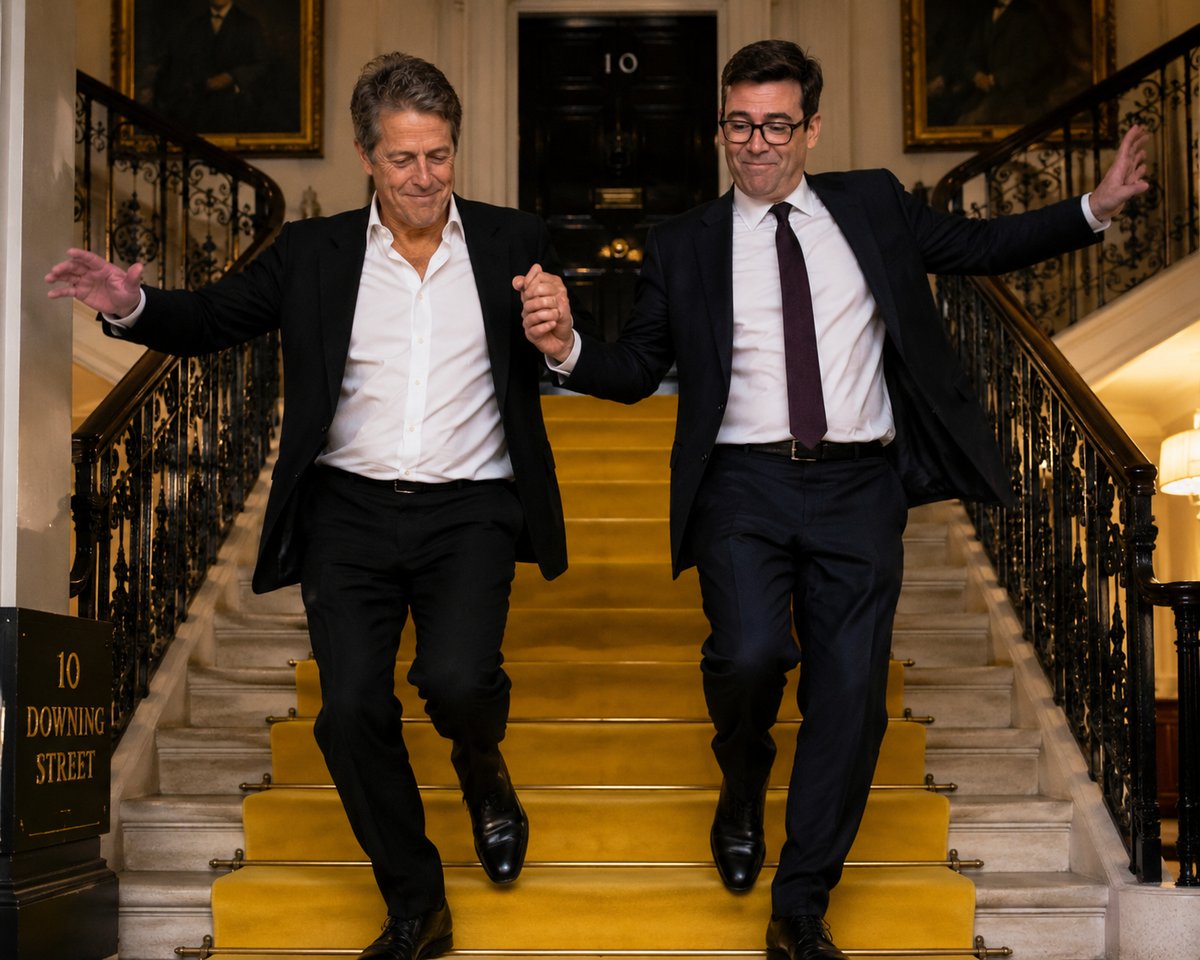
When Sir Keir Starmer announced his resignation as Prime Minister and leader of what the Free Speech Union has described as the most authoritarian government in modern history, it warned that his likely successor, Andy Burnham, would be even more hostile to free speech and a free press.
Mr Burnham — dubbed the "King of the North" — has already been observed avoiding questions from the press as he sketches out his vision for government.
One of the first battles the Free Speech Union envisages fighting against the new Prime Minister concerns his long-standing support for press regulation, a cause emboldened by one of his celebrity backers, the actor Hugh Grant.
Last week, the Love Actually star declared to a gathering in Westminster: "As we switch leadership of the Labour Party, switch prime ministers, there's a chance finally to get something done," the actor and press regulation campaigner told a gathering of like-minded activists.
"All I say to whoever is the new prime minister is when you're weighing up whether to do the right thing for the people against a massive corporation or to cosy up to those giant corporations for your own political career, bear this in mind: those media organisations are going to pour a bucket of s--- over you whatever you do. Whether you support them or whether you don't."
Grant's handle on X – formerly Twitter – is "@HackedOffHugh," a reference to the well-funded pressure group Hacked Off, which has for the last fifteen years called for state regulation of Fleet Street. It is also a leading advocate for the second part of the Leveson Inquiry, commonly known as Leveson 2.0, launched in the wake of the phone hacking scandal.
The first part of the inquiry was completed during David Cameron's premiership in 2011/2012, but successive governments have since rejected calls for Leveson 2.0. Sir Keir Starmer announced in his first month in office that he would not proceed with it.
Grant did not disguise his frustration with the outgoing Prime Minister, stating: "If ever there was a case in point, it's Keir Starmer, who last week was at the Murdoch summer party pretty much wearing a bucket of s---".
He went on to add: "So this is a chance for someone new to be — in my opinion — a statesman instead of a politician, to govern instead of just playing Westminster snakes and ladders, to protect the public rather than protect vested interests. So let's hope this is a hopeful moment — it just might be."
However, the ascendency of Andy Burnham appears to have re-energised Hugh Grant and his desire to suppress the free press in this country. Grant was seen campaigning for Burnham — as was the comedian Steve Coogan — during the Makerfield by-election.
The chief executive of Hacked Off, Nathan Sparkes, told The Telegraph: "People are very disappointed in Keir Starmer's record on this, really disappointed, and hopeful that a change of administration would be more open to keeping their commitments.
"We are definitely hopeful. Frankly, Keir Starmer in his two years has done nothing on regulation despite the promises on that, and has kept to the Tory position of not re-establishing Leveson part two.
"There's no more that he could have really offered to newspaper owners as far as we're concerned. So in that sense it can't get worse."
Andy Burnham is known to be a supporter of greater state regulation of the press and campaigned for it during his last spell in Parliament, serving as Shadow Home Secretary under Jeremy Corbyn. In that role, he described Leveson 2.0 as "non-negotiable," a position intrinsically linked to his campaigning on the 1989 Hillsborough disaster.
Byline Times has also reported that during a chance encounter in March, Burnham said "I haven't given up on [Leveson part two]" and that he would enact it "if he had the influence".
Burnham was also a proponent of Section 40 of the Crime and Courts Act 2013, legislation designed to force news publishers to join a state-backed regulator. Under the measures, publishers would have been liable to pay all legal costs in libel or privacy lawsuits, even if they won, unless they were members of such a regulator. These provisions were formally repealed by the last Conservative government in the Media Act 2024 before they were ever brought into force.
Burnham also has a number of other parliamentarians close to him — jostling for jobs in his administration — who are supportive of plans to push forward with Leveson 2.0. Anneliese Midgley MP, a key figure in Burnham's by-election campaign who is tipped for the role of chief whip or a No. 10 position, is a close friend of Lord Watson and has taken up his mantle in the House of Commons by calling for a debate on renewed allegations from the investigative journalist Nick Davies, who originally exposed the phone-hacking scandal.
Another figure who has been keen to target journalists and anyone who seeks to challenge the political doctrine of his masters is Josh Simons, the former head of Labour Together and ex-MP for Makerfield, who resigned to help return Andy Burnham to Parliament. Simons has been tipped for a senior role at the heart of Burnham's Downing Street operation. The Free Speech Union recently exposed the shadowy Labour "misinformation mafia" operating across Westminster, and the scandal that led to Simmons's fall from political grace under Sir Keir Starmer.
These heavy-handed tactics could not come at a worse time for newspapers, which are already grappling with the threat posed by the digital media age. Over the course of the last twenty years, roughly three hundred local papers have shut down, and paid national daily and Sunday newspaper sales have dropped by over sixty per cent in the last decade.
The Government has recently announced plans to prioritise "trustworthy" platforms on people's social media feeds. This is beyond dystopian, as the Reform UK MP Robert Jenrick highlighted in the House of Commons last week. In a free society, no government, agency, or unelected civil servant should have the power to decide what citizens are permitted to see.
As reported in The Telegraph, "The move would inarguably represent a significant new incursion by the state into influencing speech online and would be sure to further escalate hostilities with the Trump administration".
Since the Southport riots in the wake of the heinous murders, Ofcom has raised concerns about the spread of material on social media, and public order legislation has since been used zealously to stifle dissent and protest.
The Free Speech Union warned that Andy Burnham would take up Starmer's mantle as an enemy of free speech and become a successful recruiting sergeant for the organisation. It awaits the free speech battles it must fight — and win — under Burnham's premiership.
Worried about the state tightening its grip on the free press?
The FSU defends press freedom and opposes state regulation of the media, including the revival of Leveson 2.0. Join 49,000 members who speak freely. From £29.99/year.
Join the FSU Today