South Wales Police enforcing its own Islamophobia definition that will have a chilling effect on free speech
2 June 2026
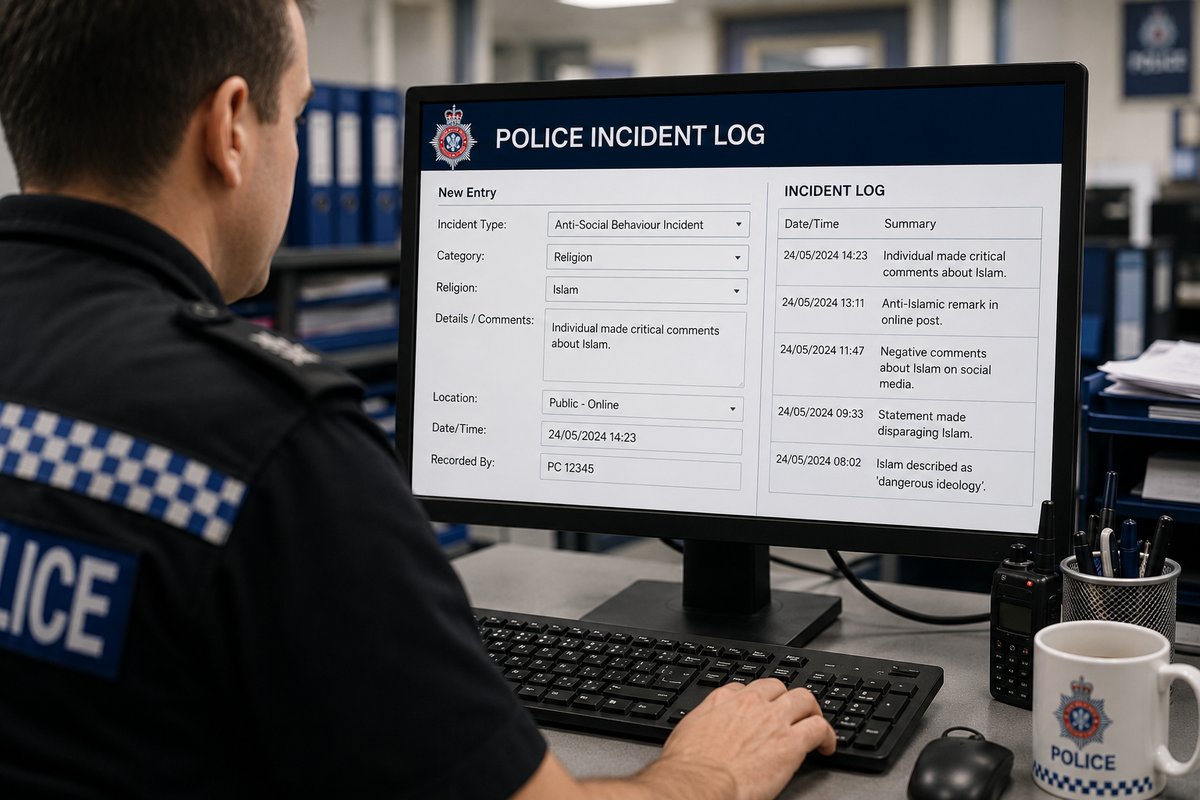
South Wales Police has told its officers that they must log anti-Islam conversations under new guidance.
The force has told officers that this includes anything that goes beyond "legitimate" discussion of Islam. But what constitutes "legitimate" discussion of Islam in a country that abolished blasphemy laws 18 years ago?
It is painfully clear that this subjective guidance hands officers the power to decide what constitutes acceptable speech about Islam — which will inevitably have a chilling effect on freedom of expression.
Should an officer decide that someone has crossed the line of what they deem acceptable speech about Islam and Muslims, the police will in all likelihood create a record of an anti-social behaviour incident — in the absence of the Orwellian non-crime hate incident (NCHI) — which could then be disclosed in an enhanced DBS check and prevent someone from getting a job.
The Free Speech Union has written to South Wales Police requesting that it withdraw its guidance, and threatening legal action by way of judicial review should it fail to do so.
The Free Speech Union's General Secretary and founder has said that the force now risks "penalising people for expressing misgivings about Islam", contrary to free speech protections enshrined in law.
Lord Young told The Telegraph: "The Government was careful to include free speech safeguards in its official definition of anti-Muslim hostility, making clear that it was not intended to inhibit criticism of Islam or Islamic religious practices, such as ritual public prayer.
"Our concern is that police forces and other public bodies adopting the definition will gold-plate it, ignoring those safeguards and penalising people for expressing misgivings about Islam, even when those views are rooted in evidence rather than prejudice.
"In particular, we are concerned that the default police response to reports of anti-Muslim hostility — even where they clearly fall outside the definition — will be to record them as 'anti-social behaviour incidents', the new name for 'non-crime hate incidents'. Those records may then be disclosed in enhanced DBS checks."
The Free Speech Union has long warned that an official Islamophobia definition would become a de facto blasphemy law, silencing legitimate criticism and debate of Islam. That warning has been vindicated repeatedly in the three months since the Government announced its new "anti-Muslim hostility definition".
After Shadow Justice Secretary Nick Timothy criticised a mass Muslim public prayer event in Trafalgar Square, Labour MPs reported him to the Parliamentary Commissioner for Standards, branded him an Islamophobe, and he faced calls to resign from the Prime Minister.
Last week, 27 Labour backbench MPs wrote to the Equality and Human Rights Commission (EHRC) accusing Reform UK of Islamophobia and urging an investigation. The letter was coordinated by Afzal Khan MP, a leading campaigner for an official definition of Islamophobia.
Forty-five minutes after the definition was announced by the Communities Secretary in the House of Commons, pro-Gaza MP Iqbal Mohamed asked for it to be incorporated into the Nolan Principles of Public Life — a move that would have resulted in MPs and peers being sanctioned should they fall foul of this vague and subjective definition, or even raise sensitive matters such as the grooming gangs scandal or Islamist extremism.
The Telegraph also revealed the story of a Free Speech Union member who was sacked from her role as chair of Bradford Police Scrutiny Panel after insisting that West Yorkshire Police address the "elephant in the room" of Islamist extremism at an emergency meeting held in the wake of the terrorist attack on a synagogue in Manchester.
While the Government's definition of Islamophobia poses a threat to free speech, the definition adopted by South Wales Police goes further. South Wales Police's interpretation adds an extra phrase to the Government's definition that could have a chilling effect on free speech and adversely affect people's employment prospects.
As a result of this policy, individuals may be unable to predict whether their lawful speech or beliefs will be recorded by the police, or how any resulting record may be used, retained, or relied upon.
Lawyers at the Free Speech Union wrote in their letter to South Wales Police: "The memo issued by South Wales Police gives rise to an unjustified chilling effect on lawful expression and belief.
"Individuals are deterred from expressing religious, philosophical or political views, or from manifesting their beliefs, by the knowledge that doing so may result in police categorisation and recording as an instance of hostility, notwithstanding the absence of any criminal conduct."
It is believed that several other police forces have adopted a similar approach.
Had a non-crime hate incident logged against you by the police?
The FSU has campaigned to scrap NCHIs — and members like you made it happen. Join 45,000 members. From £29.99/year.
Join the FSU Today