
Free speech survived at Oxford last night — but only just
18 November 2026
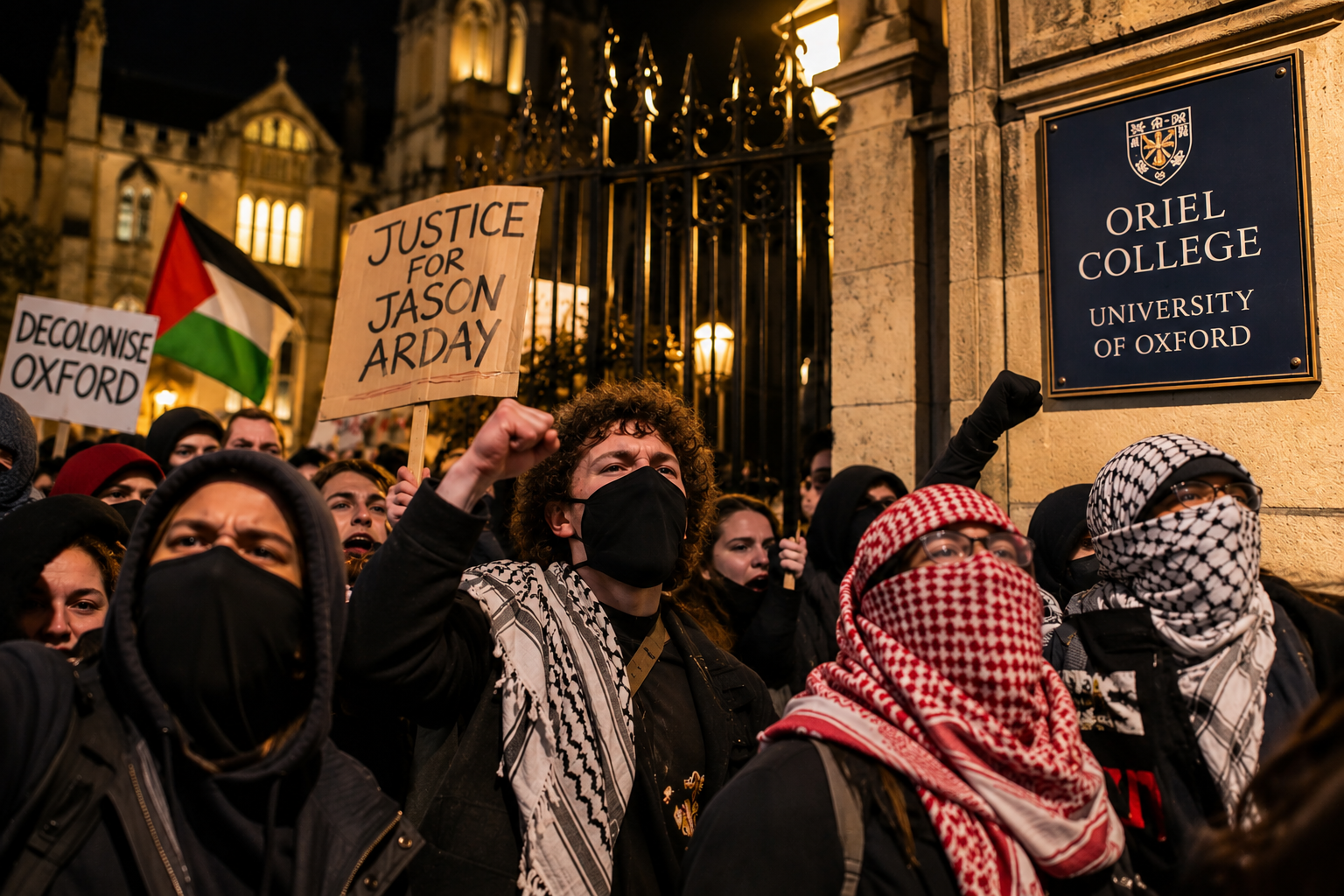
Free speech prevailed at Oxford last night against the ugly face of the cancel-culture mob that tried to silence Nathan Cofnas.
But the mob came dangerously close to winning.
Militant protesters tried to disrupt a talk at Oriel College by Dr Cofnas, the self-described “race realist” academic who, in July, was among the first to accuse the late Professor Jason Arday of plagiarism. Dr Cofnas had been invited by the Oxford Reform UK Society to speak on the question “Is DEI undermining higher education?” The event was met with fierce opposition.
Hundreds of protesters gathered in Oriel Square. Masked activists tried to blockade the college’s entrances, barricading the side gate on Magpie Lane and forming a picket line outside the college’s Island Site. Some later breached Oriel’s main gate, while at least seven climbed over a wall into the college. Even Oriel’s own students were left unable to reach their rooms.
As Tom Slater wrote in The Spectator, the police were “either overwhelmed or nowhere to be seen”. Thames Valley Police later said that an assault, and an assault on a police officer, were being investigated, but that no arrests had been made. Among those caught up in the chaos was the Free Speech Union’s own External Affairs Officer, Connie Shaw, who said that she was “physically pushed into a wall and cornered by masked men” as she tried to reach the talk.
Dr Cofnas is no stranger to the cancel-culture mob. In 2024, Cambridge placed him under investigation over a blog post on race and meritocracy. Fourteen distinguished academics, including Steven Pinker, Peter Singer, and the Oxford philosophers Amia Srinivasan and Jeff McMahan, wrote to The Times in his defence. The investigation concluded that his views, however offensive many found them, broke neither the law nor the university’s regulations. His accusations against Professor Arday this summer then brought him to international attention, and made him a target once again.
In the weeks before the event, Oriel faced considerable pressure to cancel. More than 30,000 people, including Jeremy Corbyn and Diane Abbott, signed a petition demanding that the talk be called off, and student bodies, academics, and alumni lined up to denounce it. The college stood firm, and its decision deserves recognition. Its Provost, Lord Mendoza, told students that the college wanted “to live up to our statutory duty to protect free speech – free speech for the event and those to protest it.” That is exactly the right principle. More than 170 academics, including Oxford professors, signed a letter organised by the Free Speech Union to Lord Mendoza.
Oriel’s decision to continue with the Oxford Reform UK Society’s event also points to an important legislative victory of the last Conservative government. The Higher Education (Freedom of Speech) Act 2023 strengthened the statutory duty on universities, and for the first time on their constituent colleges, to secure free speech on campus. Without that duty, it is far from certain that last night’s talk would have gone ahead at all.
Yet last night’s shocking scenes are a sad reminder of the dire state of free speech on university campuses, particularly at Oxford and Cambridge. A generation of students has been taught that hearing an argument is the same as endorsing it, and that the proper response to an idea they dislike is to stop anyone else from hearing it.
An Oxford Brookes student told the BBC: “Oxford University is a prestigious university, and what is talked about here is talked about around the world. Giving this sort of conversation a platform is legitimising it essentially.”
That is not how free speech works. This censorious view is held by far too many students, and it should alarm us. It is an arrogant, metropolitan and closed-minded perspective.
A BBC article included the views of those who objected to Cofnas’s talk, but not of anyone who wanted to hear what he had to say. Why might that be?
Slater put it well: “The brittle authoritarianism of today’s ‘progressives’ has left them intellectually disarmed — incapable of understanding, let alone challenging, ideas they oppose.”
He added: “The hysteria of the protesters is born of intolerance; their intellectual weakness betrayed by their demands for censorship.”
Dr Cofnas was thankfully able to speak, albeit to an audience of around two dozen people, in a hall that was reportedly only a third full. That was not for want of interest. Many who wanted to attend were simply unable to reach the venue. Dr Cofnas was not denied his right to speak, but many more were denied their right to listen.
That should trouble anyone who cares about what a university is for. If Dr Cofnas is wrong, the answer is to hear him out and prove it, not to barricade the door.
Read more in The Times.
Could a mob stop your next event?
The FSU rallied 170 academics behind Oriel College's stand for free speech — and we fight censorious mobs wherever they strike. Join 50,000+ members. From £29.99/year.
Join the FSU Today