
Oxford professor cancels lecture series after pro-trans activist abuse
10 June 2026
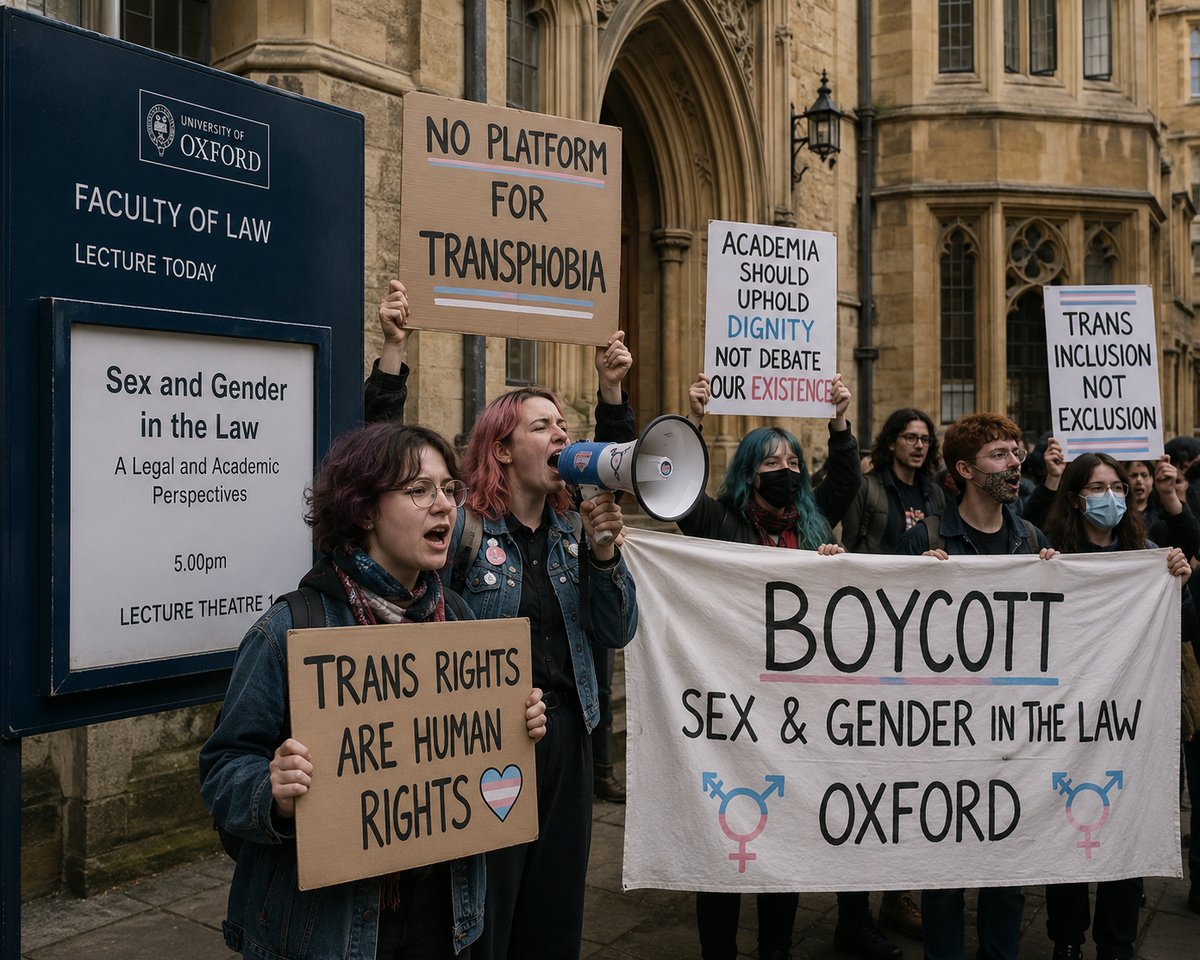
Dr Michael Foran, an associate professor of law at the University of Oxford, has been forced to cancel his four-part lecture series halfway through after sustained abuse from trans activists.
Foran is a highly regarded and authoritative voice on equality and gender law. He was also cited during last April’s landmark Supreme Court ruling on the meaning of “sex” in the Equality Act 2010.
Posting on X, Foran announced that he would be cancelling the remaining lectures addressing the themes in his new book, Sex, Gender Identity and the Law. He wrote: "This is deeply lamentable, but the disruption has undermined the academic nature of this series." He added: "Students shouldn't face bullying or harassment when attending academic events."
Foran went on to say: "It is unfortunate that these protesters have chosen disruption over genuine intellectual engagement grounded in academic charity and rigour. In attempting to shame students into de-platforming these lectures, they manifest the antithesis of what a university stands for."
The lectures focused on the themes within his new book, examining how sex and gender have shaped the law in relation to controversies over single-sex spaces, freedom of expression, privacy, sport and sexual intimacy.
Footage recorded by audience members shows trans activists disrupting two separate events at the HB Allen Lecture Theatre, which were open to both students and members of the public.
As Foran was preparing to begin his first lecture on 29 May, two protesters marched to the front of the hall and addressed the audience from the lectern.
One protester claimed that Foran "masks his transphobia behind a thin veneer of academia". He went on to say: "If you are here in a critical capacity to challenge his ideas... that is not the same as refusing to platform him. He will not be convinced by your arguments. Please join me in walking out and refusing to platform this bigot."
Members of the audience pleaded for the protesters to leave so that the lecture could proceed.
When the second lecture took place on 5 June, the same two protesters returned and once again addressed the audience. This time they were met with louder demands to leave, which drowned them out. Once they had gone, two further protesters who had concealed themselves among the crowd rose and continued the disruption before being escorted from the premises.
A PhD student attending the lecture told The Telegraph: "I found it very intimidating. The attacks were pretty personal. For all of us there, it was pretty unacceptable at this sort of academic event."
An anonymous source present at the lectures said the proctors' office gave permission for the protests to go ahead — the proctors being responsible for ensuring the university's policies are observed by students. It has been reported that despite students complaining to that office about the first protest, officials still allowed the same activists to disrupt the second lecture.
This episode is a damning indictment of the inability — or unwillingness — of universities to uphold free speech and academic freedom, and to discharge the responsibilities placed on them by law.
Over recent years, cancel culture has turned university campuses across the country into environments hostile to open debate. We have seen academics and students alike hounded off campus, ostracised by their peers, and subjected to sustained campaigns of abuse and harassment for holding or expressing lawful views. This trend has only worsened since Israel's military action against Hamas.
The Higher Education (Freedom of Speech) Act 2023 (HEFSA) was meant to be a turning point for free speech and academic freedom on campus. However, when Labour won the general election in July 2024, one of Bridget Phillipson's first acts as Education Secretary was to pause implementation of key sections of the Act — including the introduction of a complaints scheme.
While Phillipson has since U-turned and announced that a complaints scheme will be implemented in September, that does little to help Foran. He is currently unable to complain about Oxford's failure to discharge its free speech duties, as the scheme is not yet operational.
A spokesperson for the University of Oxford has, as expected, issued a mealy-mouthed commitment to free speech and academic freedom. That is no longer enough. Universities — if they wish to remain prized and respected institutions — must do more than pay lip service to free speech.
Facing pressure at work for your gender-critical beliefs?
The FSU has a strong track record defending people investigated or disciplined for gender-critical speech. Join 45,000 members. From £29.99/year.
Join the FSU Today